
Read the public record on any issuer, sponsor or fund, before you sign, commit or sell.
Each issuer's filings as filed, the funds on its sponsor's registration, the firms paid to sell its offerings, and the dates the rules attach to them.
Search nearly 600,000 filings since 2015, by issuer, state, industry, amount and date.
New filings are added every weekday*, and every list opens each filing's own page, with its official record one click away.

The firms behind an issuer
The chart at the top of this page shows an adviser's structure as its page draws it: the fund families and their vehicles on its latest registration, the offerings those funds cite, and the firms each filing names as paid to sell.
Every line in the chart is a link the filings make themselves: a Schedule D file number joins a fund to an offering, and an Item 12 name joins a placement agent to it. Nothing is joined by inference from a name.
Form D records an issuer's executive officers, directors and promoters, not its owners, and SERA IQ makes no claim about who owns what. Each filing's page shows the people it names as filed, by name and title, with city and state only.
- AdviserThe firm on its latest Form ADV
- Fund familyIts vehicles on Schedule D 7.B.1
- Form D offeringCited by file number
- Placement firmNamed in Item 12
Sanctions listings and SEC orders
Where the record links one to a firm, the firm's Record tab, and its profile in Find capital, show its entry on the U.S. Treasury's sanctions lists (OFAC): the list and the programs, the entry's number and the date of the list as OFAC published it, the name and address the entry prints, the fact that links it to the firm (the same name, and the same city and country, or a website or phone number printed in the entry), and OFAC's own page for the entry. Find capital's lists and Records search's results say so in one line.
An issuer's Record tab shows the SEC orders that name the company by its CIK beside its own name: whether the SEC alleged or found and, where the order says so, that the company consented without admitting or denying the findings; the order's title, release numbers and date, and the order on sec.gov. The page states the date from which orders are covered and that later developments may not be shown.
Any organization's name can also be looked up on the Sanctions lists page, in OFAC's lists as SERA IQ holds them: every entry whose names contain each word typed, shown as OFAC prints it (its names and a.k.a.s, addresses, programs, list and entry number, and the date the list was published), with a link to the entry on OFAC's website. The lists held cover organizations and other entities, not individuals; a person is looked up on OFAC's own search.
OFAC's lists and the SEC's orders are read every night. SERA IQ is not a sanctions screening service. A firm with no entry shown is not cleared, and SERA IQ says nothing about it.

Change alerts
An issuer can be followed from any of its filings, and a firm from its page. Its next filing, new or amended, is reported on the Watchlist and by email, weekly on Mondays or each weekday it has news. A week without news sends nothing.
For a followed adviser, the email also reports when a registration filing moves its assets under management up or down 25% and $250M or more against its filing a year earlier, and each private fund it reports for the first time with $25M or more, other than series and co-investment vehicles. Each change is reported once.
Each client's or mandate's issuers, firms, raises and exports can be kept in a workspace of its own, with a private note visible only to the account.

Uses by role
Attorneys, compliance teams, family offices and service providers each read the same records for a different purpose, each from a different screen of SERA IQ. Every screen here is the product; the firms shown are fictional.
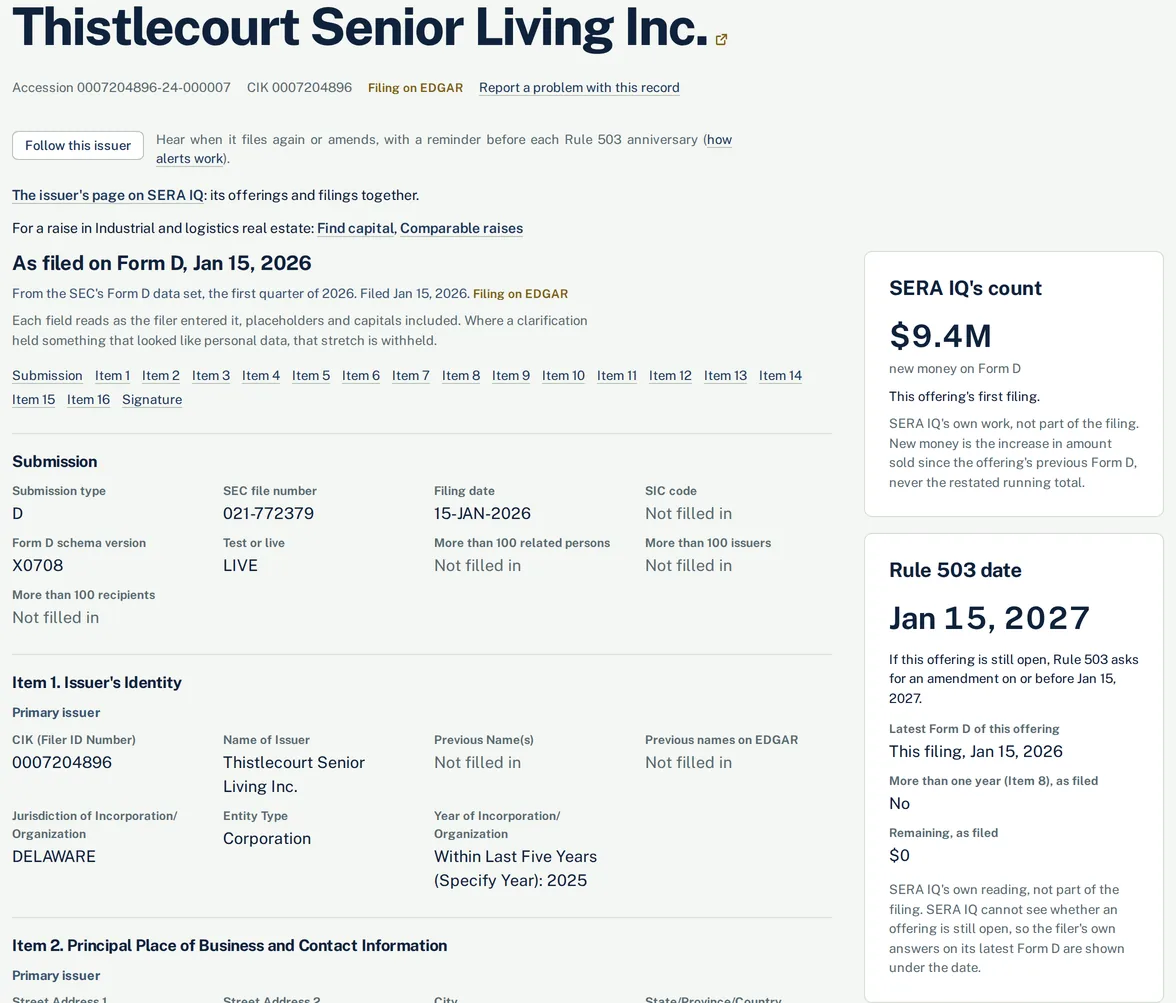
Attorneys and securities counsel
An issuer's history in its filings: every filing and amendment of each offering, read as filed, with its official record one click away.
Uses: filings as filed, Rule 503 dates, following an issuer to see when it files again or amends.
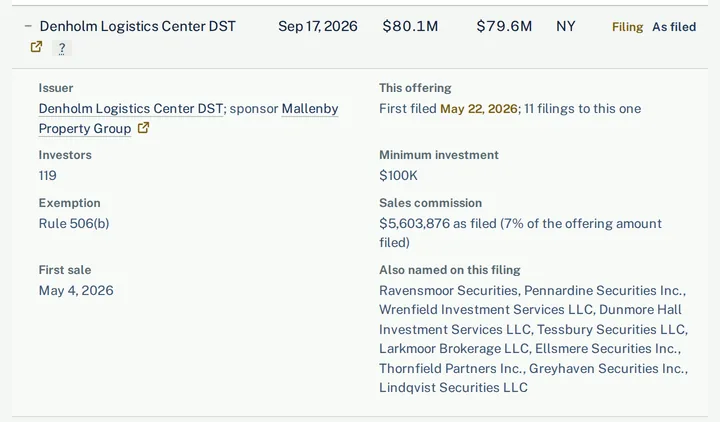
Compliance at placement firms and advisers
The other firms paid to sell an offering, as each filing names them, and the record of offerings a sponsor has filed.
Uses: the firms each filing names as paid to sell, the firms behind an issuer, OFAC entries and SEC orders on a firm's Record tab.
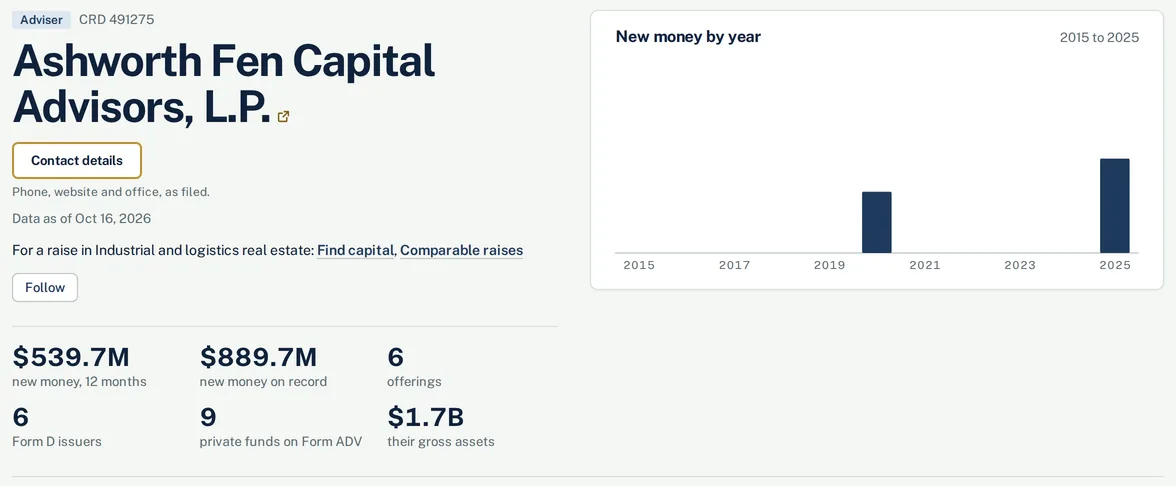
Family offices and investment teams reading a sponsor's record
A sponsor's funds on its registration, the offerings they cite, the new money each reported, a raise filed several times counted once, and the firms paid to sell it.
Uses: the adviser's page and its structure chart, new money by offering.
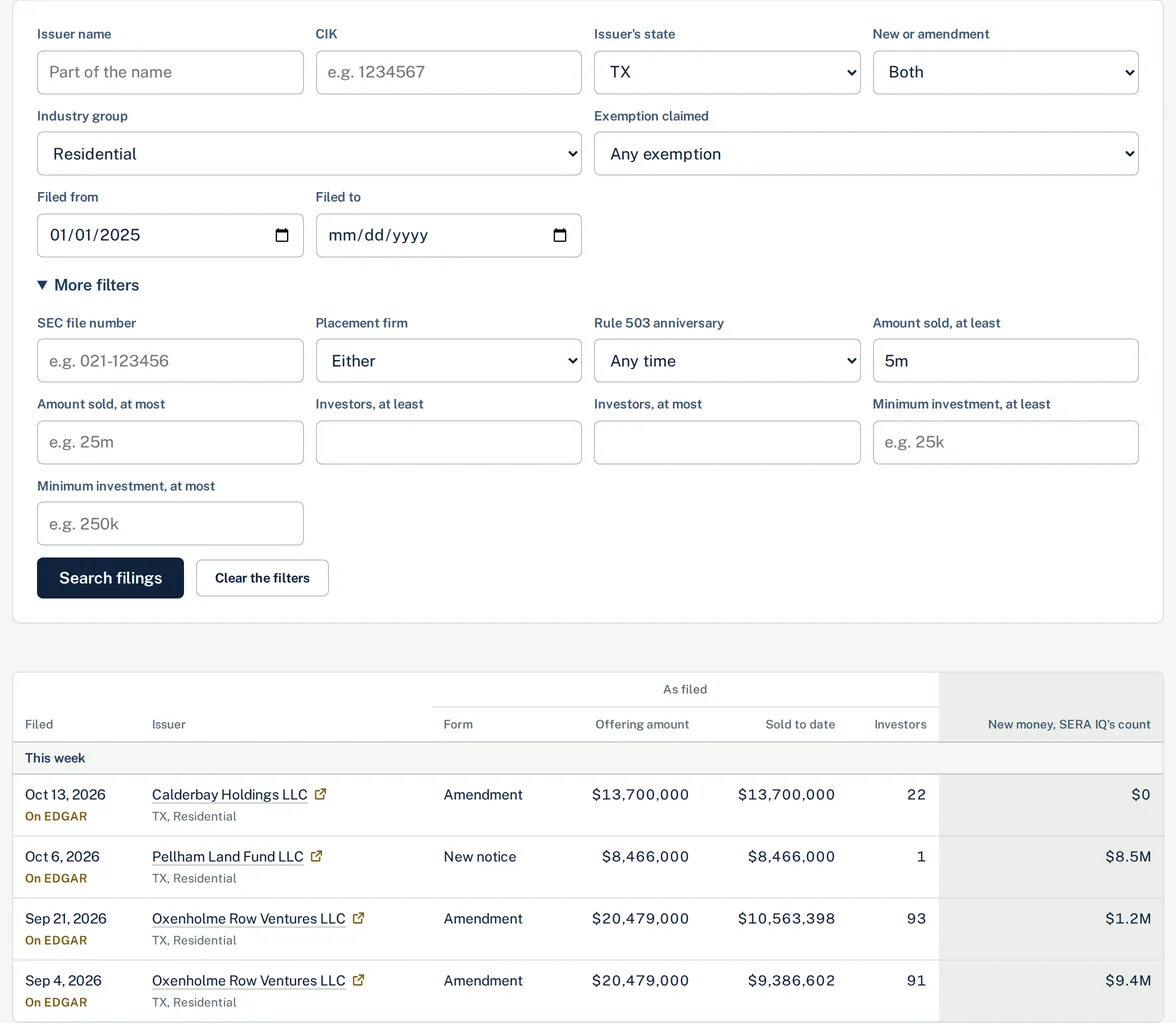
Fund administrators, auditors and service providers to issuers
Current issuers by asset class, state and size: new filings every weekday*, searchable by issuer, state, industry, amount and date.
Uses: Search filings, new money by class.
Illustrative example: the firms shown are fictional. Layout and figures from SERA IQ on October 17, 2026. Sources: U.S. Securities and Exchange Commission, EDGAR.
SERA IQ is built around firms and filings. How it shows the people a filing names is set out below, under People, as filed.
People, as filed
Each filing's page shows the people it names as filed with the SEC: name and title, with the city and state of the address the filing gives, never a person's street, ZIP code or phone number. SERA IQ adds nothing to these records, does not link them to records from other sources and builds no profile of any person. Name search, including the person search of SERA IQ's Records search page, finds the filings that name a person, for business use only.
Not for screening. SERA IQ may not be used as a factor in deciding anyone's eligibility for credit, insurance, employment, housing or any other purpose covered by the Fair Credit Reporting Act, or in deciding whether to hire, engage or retain a person as an employee, registered representative, agent or independent contractor. SERA IQ is not a consumer reporting agency.
A person named in a filing can ask us to withhold a row: Request a removal.

Rule 503 dates
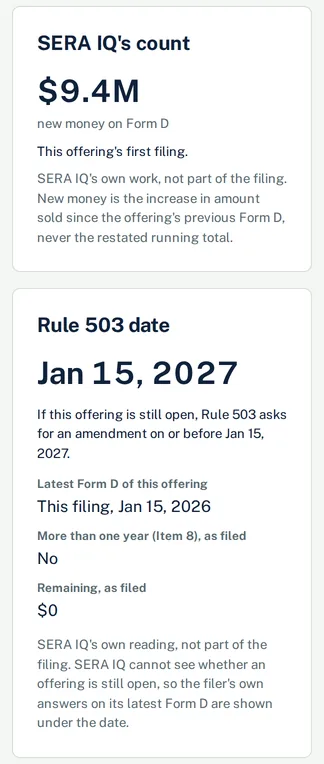
What the rule asks. Rule 503 of Regulation D asks an issuer that relies on Rule 504 or 506 to amend its Form D each year, on or before the first anniversary of its most recent filing, if the offering is still open.
How SERA IQ dates it. From the offering's latest Form D: the same day a year later, with no weekend roll.
What SERA IQ cannot see. Whether the offering is still open. So the filer's own answers sit under the date, as filed: whether the offering runs more than one year (Item 8), and the amount remaining.
A filing's page states it in one of two sentences, word for word:
While the anniversary is ahead
"If this offering is still open, Rule 503 asks for an amendment on or before <date>."
Once the anniversary has passed
"If this offering was still open, Rule 503 asked for an amendment on or before <date>. SERA IQ holds no later Form D of this offering."
This is information, not legal advice.
Account allowances
Included each day: up to 150 filing pages, 100 name searches, and Search filings lists up to 500 rows deep; exports up to 5,000 filings a month.
Every export is marked to your account.
| Filing pages opened | 150 a day |
|---|---|
| Name searches | 100 a day |
| Search filings, rows deep | 500 |
| Exports, all kinds | 20 files a day |
| Filings in one export | 500 |
| Filings exported a month | 5,000, 2,500 in your first paid month |
Begin with this week's filings
Capital research from the official record, renewed every week. Subscribe now, or request a demo first: demos are by invitation, not guaranteed.
$199 a month for 24 months, up to $2,400 saved. No contract; cancel any time; your first month back within 5 calendar days if you ask and have not exported or gone past the first days' limits.
Not ready? Receive the free weekly Capital Brief.
Request a demo (by invitation)